For many small business owners in the UK, the technical side of the internet feels like a hurdle rather than a helper. You know you need a digital presence, but the jargon—SEO, CSS, hosting, UX—can be overwhelming. Yet, the reality is stark: your shop window isn’t just on the high street anymore; it is in the palm of your customer’s hand.
A website is often the very first interaction a potential client has with your brand. If that interaction is slow, confusing, or visually unappealing, they won’t hesitate to click the ‘back’ button and visit a competitor. Your digital footprint is arguably your most valuable marketing asset, working for you 24 hours a day, 365 days a year.
Understanding web design and development is no longer optional for business owners who want to scale. You do not need to learn how to write code, but you do need to understand the principles of what makes a site successful. This guide breaks down exactly what small businesses need to know to build a high-performing website that converts visitors into loyal customers.
Web Design vs. Web Development: What is the Difference?
Before commissioning a new site, it is vital to understand that “web design” and “web development” are two distinct disciplines, even though they are often bundled together.
Web Design focuses on the visual aesthetics and usability of the website. A designer is concerned with colour schemes, layout, flow, and how the user interacts with the information. They use tools like Adobe XD, Figma, or Photoshop to create the look and feel. Their goal is to ensure the site represents your brand identity and encourages users to stay.
Web Development, on the other hand, is the engine room. Developers take the static design created by the designer and turn it into a fully functioning website using coding languages like HTML, CSS, JavaScript, and PHP. They ensure that when a user clicks a button, it actually does something.
For a small business, you need a strategy that integrates both. A beautiful site that doesn’t work is useless; a functional site that looks terrible will destroy your credibility.
Why Professional Web Design and Development Matters
It is tempting to look at drag-and-drop website builders and assume you can create a professional website in an afternoon. While these platforms may work for personal projects or temporary landing pages, they often fall short for businesses that want to grow, compete, and convert consistently. Professional web design and development provide a robust, scalable foundation that supports your brand, your marketing, and your long-term business goals.
A professionally built website is not just about appearance—it is about performance, credibility, visibility, and user behaviour. Every design choice and development decision directly impacts how customers perceive your business and whether they choose to engage with it.
Credibility and Trust
First impressions online are formed almost instantly. Studies show users take as little as 0.05 seconds to decide whether a website feels trustworthy. In that brief moment, visitors subconsciously assess layout, typography, colour harmony, and structure. If a website looks outdated, cluttered, or inconsistent, potential customers may assume the same about the business behind it.
Professional web design and development ensure your website reflects legitimacy and authority. Clean layouts, consistent branding, modern design patterns, and intuitive structure signal that your business is established and reliable. Trust is especially critical for small businesses, where customers may not yet recognise your brand. A well-designed website reassures visitors that they are dealing with a credible organisation, not a risk.
Search Engine Visibility (SEO)
A visually impressive website has little value if it cannot be found. Search engines like Google prioritise websites that are technically sound, fast, and easy to understand. Professional web development focuses on clean code, logical site architecture, and optimised performance—elements that search engine crawlers rely on to index and rank your pages correctly.
Key SEO factors such as proper heading hierarchy, optimised images, fast loading speeds, mobile responsiveness, and structured internal linking are often overlooked in DIY website builders. Poor technical foundations can lead to bloated code and slow performance, which negatively affects rankings. With professional web design and development, SEO is built into the structure of the site from day one, giving your business a far stronger chance of appearing in relevant search results and attracting qualified traffic.
User Experience (UX)
User experience is where design, psychology, and development intersect. A professionally designed website anticipates how users think, scroll, click, and decide. Every element—from navigation menus to button placement—is intentionally designed to guide visitors towards a specific action.
Whether the goal is to book a consultation, request a quote, or complete a purchase, effective web design and development removes friction from the journey. Pages load quickly, forms are easy to use, content is scannable, and calls to action are clear. When users can effortlessly find what they need, they stay longer, engage more, and are far more likely to convert into customers.
Core Elements of a Successful Small Business Website
When planning a web design and development project, certain elements are non-negotiable. These are not “nice-to-haves” or design trends that come and go—they are the structural pillars of a high-performing website. Without them, even the most visually attractive site will struggle to generate leads or sales.
At SanMo UK, these are the core elements we prioritise when building digital assets that are designed to grow alongside small businesses.
1. Mobile Responsiveness
More than half of all global web traffic now comes from mobile devices, and for many small businesses, mobile users represent the majority of enquiries and purchases. If a website forces users to pinch, zoom, or struggle with tiny buttons, they will abandon it almost immediately.
Responsive web design and development ensure that your website automatically adapts to different screen sizes and orientations. Text remains readable, images scale correctly, and navigation stays intuitive whether a visitor is using a desktop, tablet, or smartphone. Beyond user convenience, mobile responsiveness is also critical for SEO. Google uses mobile-first indexing, meaning it primarily evaluates the mobile version of your site when determining search rankings. A non-responsive site is therefore at a severe disadvantage.
2. Fast Loading Speeds
Speed is no longer optional—it is expected. In an age of instant access, users have little patience for slow-loading websites. Research consistently shows that if a page takes longer than three seconds to load, bounce rates increase dramatically, resulting in lost opportunities and revenue.
Professional web development focuses heavily on performance optimisation. This includes compressing images without sacrificing quality, minimising code, leveraging browser caching, and choosing reliable hosting infrastructure. Cheap themes and DIY builders often introduce bloated code that slows down performance. A fast-loading website not only keeps users engaged but also improves search engine rankings, as page speed is a confirmed ranking factor.
3. Clear Navigation
A website should feel effortless to use. Visitors should never have to stop and think about where to click next. Clear, logical navigation allows users to quickly find essential information such as services, pricing, contact details, and FAQs.
Effective web design and development prioritise simplicity in menu structure and page hierarchy. A “flat” architecture—where important pages are reachable within three clicks—is considered best practice for small business websites. Clear navigation reduces frustration, improves user experience, and increases the likelihood that visitors will complete desired actions rather than leaving for a competitor’s site.
4. Strong Call to Action (CTA)
Every page on your website should have a defined goal. A Call to Action (CTA) tells visitors exactly what to do next, whether that is calling your business, requesting a quote, booking an appointment, or making a purchase.
In professional web design, CTAs are strategically placed, visually distinct, and written in clear, action-oriented language. They are positioned where users naturally pause or make decisions, not hidden at the bottom of a page. One of the most common mistakes in DIY websites is either having no clear CTA or overwhelming users with too many competing actions. A well-designed CTA focuses attention and significantly increases conversion rates.
The Development Lifecycle: What to Expect
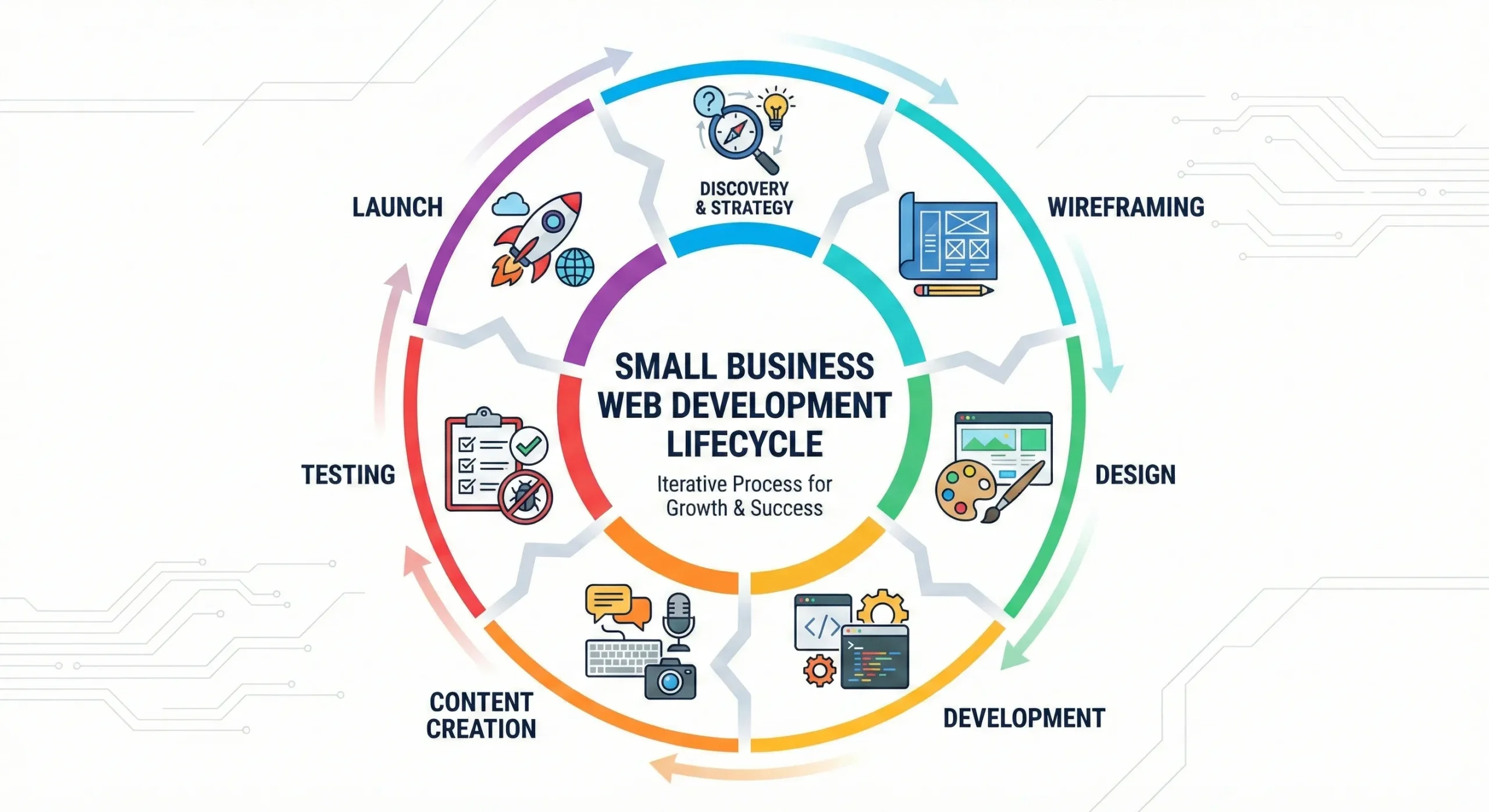
Building a professional website is not a single task—it is a structured process. Understanding the web design and development lifecycle helps small business owners set realistic expectations, collaborate effectively, and avoid delays.
Discovery and Strategy
This initial phase lays the foundation for the entire project. The agency takes time to understand your business, target audience, goals, competitors, and industry landscape. Decisions made here influence everything from site structure to functionality and content strategy. A strong discovery phase ensures the website is aligned with your business objectives, not just visually appealing.
Wireframing
Wireframes are visual blueprints of your website. They strip away colours, images, and branding to focus purely on layout, structure, and user flow. This stage allows both parties to agree on where key elements—navigation, CTAs, content sections—will live before design and development begin. It prevents costly changes later in the process.
Design
Once wireframes are approved, visual design begins. Branding elements such as colours, typography, imagery, and spacing are applied to bring the site to life. This is where your brand identity is translated into a digital experience. Professional web design ensures consistency across all pages and creates a look that resonates with your target audience.
Development
Development is where the designs are transformed into a fully functioning website. Using coding languages and frameworks, developers build responsive layouts, integrate functionality, and ensure everything works seamlessly across devices and browsers. This phase of web development also focuses on performance, security, and scalability.
Content Creation
Content is added once the structure and functionality are in place. This includes written copy, images, videos, and downloadable assets. Well-written content supports SEO, communicates your value clearly, and guides users toward conversion. Many agencies also offer professional copywriting to ensure the content matches the quality of the design.
Testing
Before launch, the website is rigorously tested across multiple browsers (such as Chrome, Safari, and Firefox) and devices. This phase checks for broken links, layout issues, speed problems, and usability concerns. Thorough testing ensures users experience the website as intended.
Launch
Once everything is approved and tested, the website goes live. Launch is not the end of the journey but the beginning of optimisation. A professionally built site is designed to evolve, allowing for future updates, new features, and ongoing performance improvements.
Choosing Your Path: DIY vs. Agency
Small business owners often struggle to decide between using a template builder or hiring a professional agency like SanMo UK. To help you decide, here is a comparison of what you typically get with each route.
|
Feature |
DIY Website Builders |
Professional Agency (SanMo UK) |
|---|---|---|
|
Customisation |
Limited to pre-set templates. Hard to stand out. |
Fully bespoke design tailored to your brand. |
|
SEO Capabilities |
Basic. Often bloats code, which hurts rankings. |
Advanced. Clean code and strategic structure. |
|
Support |
Generic help centres or chatbots. |
Dedicated human support and ongoing maintenance. |
|
Time Investment |
High. You have to build, write, and fix everything. |
Low. You provide input; the experts do the work. |
|
Scalability |
Difficult. Moving to a new platform later is messy. |
Built to grow with your business. |
|
Ownership |
You are often renting the platform. |
You own your website and its assets. |
The Role of Content Management Systems (CMS)
A major concern for small business owners is the ability to make updates after the site is launched. You do not want to pay a developer every time you need to change a price or add a blog post.
This is where a Content Management System (CMS) comes in. Platforms like WordPress are industry standards because they offer a user-friendly interface. A good web development partner will build your site on a CMS and provide training, empowering you to manage day-to-day content while they handle the technical maintenance and security updates.
Budgeting for Your Website
The cost of web design and development varies wildly, which can be confusing. It is helpful to view a website not as a cost, but as an investment. A cheap website that generates no leads is an expense; a higher-priced website that brings in ten new clients a month is a profit generator.
When budgeting, consider the long-term value. A custom-built site by SanMo UK is designed to last for years and grow as you grow, whereas a cheap template might need replacing in 18 months because it cannot handle your expanding inventory or traffic.
Partnering with SanMo UK
Navigating the digital landscape requires a steady hand. SanMo UK specialises in helping small businesses transition from invisible to impactful. By combining aesthetic excellence with rigorous code standards, SanMo UK ensures that your investment yields returns. Whether you need a simple brochure site to showcase services or a complex e-commerce platform, professional guidance is the difference between a website that just sits there and one that works for you.
Frequently Asked Questions
1. How long does it take to build a website?
The timeline depends on the scope and complexity of the project. A standard brochure website for a service-based business typically takes 4 to 6 weeks from discovery to launch. Larger websites, such as e-commerce platforms or custom-built solutions with advanced functionality, may take 10 to 12 weeks or longer, depending on requirements and content readiness.
2. Will my website work on mobile phones?
Yes. Mobile responsiveness is a core standard in modern web design and development. Your website will be designed to function seamlessly across smartphones, tablets, laptops, and desktop computers, ensuring a consistent and user-friendly experience on every device.
3. Do I need to provide the text and images?
You can provide your own content if you wish, but it is not required. While you are the expert in your business, writing effective website copy and sourcing high-quality visuals requires specialist skills. Agencies like SanMo UK offer professional copywriting and photography services to ensure your content supports SEO, branding, and conversions.
4. What is hosting, and do I need it?
Hosting is the service that stores your website’s files and makes them accessible online. Think of your domain name as your address and hosting as the land your building sits on. Yes, hosting is essential. We help clients choose secure, fast, and reliable hosting solutions that ensure optimal performance and uptime.
5. Can I update the website myself after it is launched?
Absolutely. We build websites using user-friendly Content Management Systems (CMS) such as WordPress. Once the site is live, you will receive training that allows you to edit text, upload images, add blog posts, and make basic updates without any coding knowledge.
6. Is SEO included in web design and development?
Yes. SEO is built into the foundation of professional web design and development. This includes clean code, fast loading speeds, mobile optimisation, proper heading structures, and SEO-friendly page layouts. Ongoing SEO strategies can also be implemented to further improve rankings over time.
7. Will my website be secure?
Security is a critical part of web development. Your website will include SSL encryption, secure hosting, and best-practice configurations to protect user data. Regular updates and maintenance further reduce the risk of vulnerabilities or attacks.
8. Can my website grow as my business grows?
Yes. A professionally developed website is built with scalability in mind. Whether you want to add new services, integrate booking systems, launch an online shop, or expand content, your site can evolve without needing a complete rebuild.
9. What happens if something breaks after launch?
With a professional agency, support does not end at launch. Ongoing maintenance and support packages are available to handle updates, backups, security checks, and technical issues, ensuring your website continues to run smoothly.
10. How much does professional web design and development cost?
Costs vary depending on design complexity, functionality, and content requirements. Rather than viewing a website as an expense, it should be seen as an investment. A professionally built website is designed to generate leads, build trust, and deliver long-term value for your business.