In the bustling digital economy of 2026, the concept of “local” has transcended physical geography. It is no longer just about foot traffic on the high street; it is about digital proximity. When a potential customer in Manchester, London, or Birmingham pulls out their smartphone and asks, “Where can I find the best…” they are not just searching; they are expressing an immediate intent to purchase. If your business does not appear in that split second of decision-making, you do not exist to them.
The landscape of search has shifted dramatically. The days of simply stuffing keywords into a webpage are long gone. Today, we navigate a complex ecosystem driven by Artificial Intelligence (AI), hyper-local intent, and Generative Engine Optimization (GEO). For businesses in the UK, understanding these shifts is not merely an advantage—it is a survival mechanism.
This comprehensive guide will explore the pivotal role of local SEO services in boosting a business. We will dissect the mechanics of how to do local SEO, explore the emerging frontiers of AI GEO SEO, and demonstrate why partnering with a local SEO agency like SanMo UK is the strategic investment that transforms local visibility into sustainable revenue.
Part 1: Decoding Local SEO in the Modern Era
What is Local SEO?
Local Search Engine Optimization (Local SEO) is a strategic process designed to optimize your online presence to attract more business from relevant local searches. These searches take place on Google and other search engines, but primarily, they manifest in the “Local Pack” or “Map Pack”—the block of three business listings that appear below the map in Google search results.
Unlike traditional SEO, which focuses on improving your site’s visibility on a national or global scale, Local SEO laser-focuses on “near me” and location-specific queries. It signals to search engines that your business is not just a website, but a physical entity with a specific location, serving a specific community.
The Difference Between Organic and Local SEO
To understand the value of local search SEO services, one must distinguish them from general organic SEO.
- Organic SEO aims to rank your website for keywords like “best digital marketing tips” or “history of SEO.” The competition is global, and the intent is often informational.
- Local SEO aims to rank your business for “digital marketing agency in London” or “plumbers near me.” The competition is restricted to a geographic radius, and the intent is transactional.
The Core Components
Successful Local SEO relies on three pillars of proximity, relevance, and prominence:
- Proximity: How close is your business to the searcher?
- Relevance: How well does your business satisfy the search query?
- Prominence: How well-known and trustworthy is your business?
Part 2: Why Local SEO Matters for UK Businesses
The United Kingdom has one of the highest rates of mobile commerce and digital adoption in the world. For a UK business, ignoring local search is akin to keeping the shutters down during peak trading hours.
1. The Rise of “Near Me” Searches
Data consistently shows that “near me” searches have grown exponentially. In 2026, these searches have evolved. Users no longer just type “coffee shop near me”; they search for specific attributes: “coffee shop near me open now with dog-friendly seating.” Local SEO services in UK must optimize for these long-tail, hyper-specific queries.
2. High Conversion Rates
Local search is high-intent. A user searching for a service locally is usually ready to act. Statistics indicate that a significant percentage of local mobile searches result in an offline visit within 24 hours. By positioning your business in front of these users, you are capturing leads at the very bottom of the sales funnel.
3. The “Zero-Click” Phenomenon
With the rise of Google’s AI Overviews and rich snippets, many users get the information they need (phone number, address, hours) without ever clicking through to a website. If your Local SEO is weak, your Google Business Profile won’t appear, and you lose that customer to a competitor whose profile is fully optimized.
4. Trust and Credibility
A business that appears in the “Local Pack” effectively receives an endorsement from Google. Users inherently trust these top three results more than the organic listings below them or the paid ads above them. A local SEO expert understands that getting you into this pack is about building trust signals that algorithms can read.
Part 3: The New Frontier: AI GEO SEO and Generative Engine Optimization

As we move deeper into the age of AI, a new acronym has entered the lexicon: GEO. However, confusion often arises because this term is used to describe two distinct but overlapping concepts: Geographic SEO and Generative Engine Optimization.
What is Generative Engine Optimization (GEO)?
Generative Engine Optimization (GEO) is the practice of optimizing content not just for traditional search engines, but for AI-driven “answer engines” like ChatGPT, Google Gemini, Claude, and Perplexity.
In the traditional model, a user searches, gets a list of links, and visits a site. In the GEO model, the user asks a question, and the AI synthesizes an answer from multiple sources.
- The Goal: To be cited as the source of the answer.
- The Strategy: This requires AI GEO SEO. It involves structuring data so that Large Language Models (LLMs) can easily parse, understand, and trust your information. This includes using schema markup, authoritative tone, and direct answer formatting.
What is Geographic SEO?
Geographic SEO is the practice of optimizing for broader regions rather than a specific street address. While Local SEO might target “Plumber in Ilford,” Geographic SEO targets “Plumbing services in East London” or “Emergency Plumber Essex.” It bridges the gap between hyper-local map results and broad national rankings.
The Intersection: AI GEO SEO
For a business like SanMo UK, mastering AI GEO SEO means ensuring that when someone asks an AI, “Who is the most reliable digital marketing agency in London?”, the AI mentions SanMo UK. This requires a shift from keyword stuffing to “Entity Optimization”—establishing your brand as a known entity in the knowledge graph of the web.
Part 4: Comprehensive Guide: How to Do Local SEO
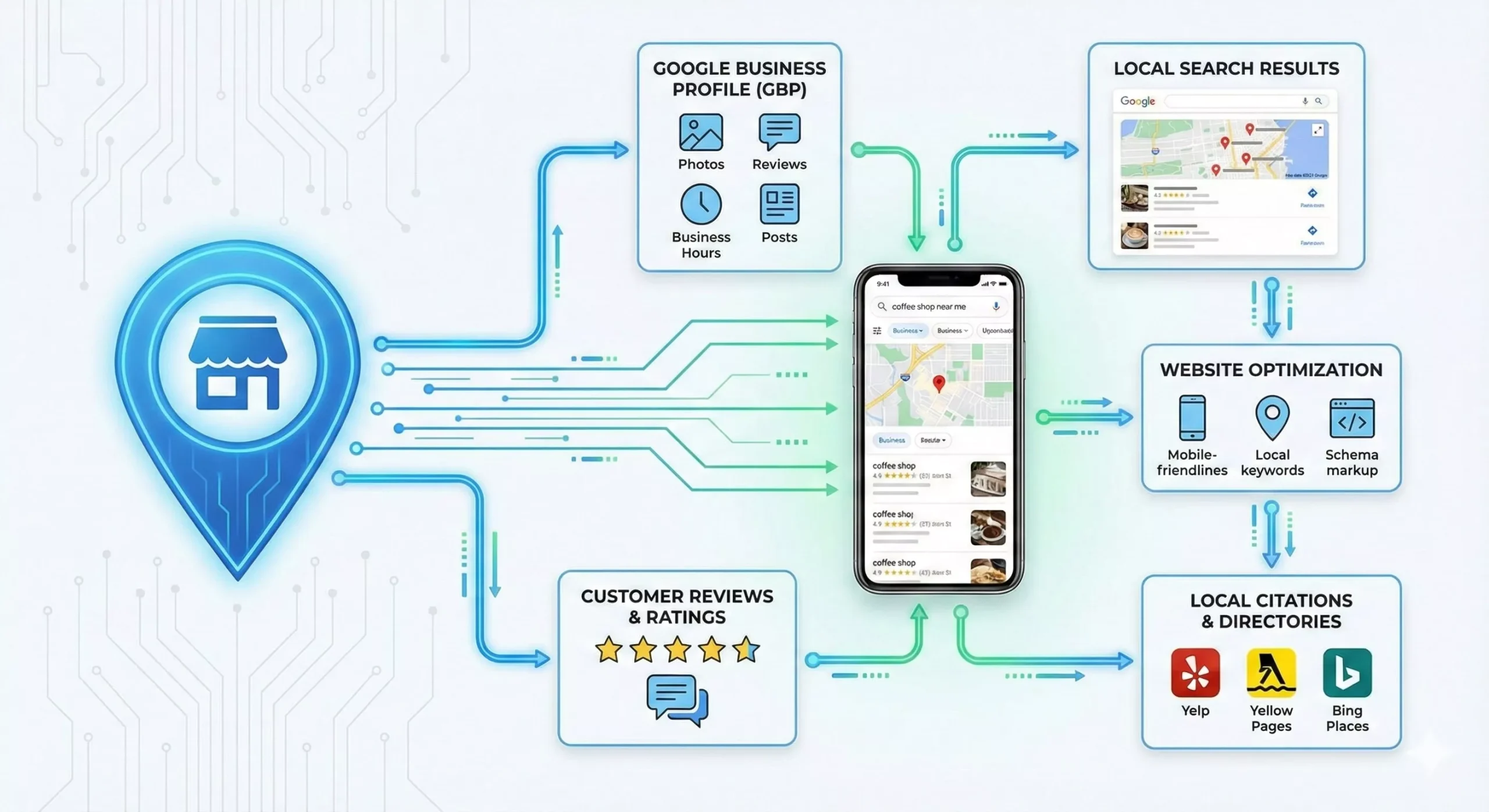
For business owners asking how to do local SEO, the process is granular and requires consistency. Here is a deep dive into the execution strategy that a local SEO agency would employ.
Step 1: Google Business Profile (GBP) Mastery
Your Google Business Profile is your new homepage. It is the single most critical factor in local rankings.
- Claim and Verify: Ensure you have ownership of your listing.
- Complete Every Field: Do not leave anything blank. Fill out services, products, accessibility info, and amenities.
- Category Selection: This is crucial. If you are a “Pizza Restaurant,” do not just list “Restaurant.” Be specific.
- Photos and Video: Upload high-quality images of your team, your office/shop, and your work. Geo-tagging these photos (embedding location data) can provide a minor but helpful signal to Google.
- Q&A Section: Pre-populate the Q&A section with common customer questions. This improves relevance and helps voice search optimization.
Step 2: NAP Consistency (The Bedrock)
NAP stands for Name, Address, Phone Number. Search engines use citations (mentions of your business across the web) to verify your existence. If your business is listed as “SanMo UK Ltd” on Yell.com but “SanMo UK” on your website, and “SanMo Limited” on Facebook, Google gets confused.
- Audit: Check all major directories (Yell, Yelp, Thompson Local, Scoot, etc.).
- Standardize: Decide on one format (e.g., “Road” vs. “Rd.”) and stick to it religiously.
Step 3: Localized Content Strategy
You cannot rank for a location if you never mention it. However, simply pasting “London” 50 times in the footer is spam.
- Location Pages: If you serve multiple areas (e.g., Ilford, Romford, Barking), create a unique landing page for each. Do not duplicate the content and just swap the city name. Write unique copy about the specific services offered in that location.
- Local Blogs: Write about local news, participate in local events, or create guides relevant to the local area. For example, “The Best Networking Events for Small Businesses in East London.”
Step 4: The Power of Reviews
Reviews are a ranking factor and a conversion factor.
- Velocity: Getting 10 reviews in one day and then zero for six months looks suspicious. Aim for a steady stream.
- Diversity: While Google reviews are king, reviews on Facebook, Trustpilot, and industry-specific sites also matter.
- Response: You must respond to every review, positive or negative. Keywords in your responses (e.g., “Thank you for choosing us for your boiler repair in Leeds“) can help with relevance, but they must sound natural.
Step 5: On-Page Local Signals
Your website code needs to speak “local” to the search engine spiders.
- Title Tags & Meta Descriptions: Include the city and service (e.g., “Local SEO Services in UK | SanMo UK”).
- Schema Markup: Use
LocalBusinessschema. This is a piece of code that tells Google explicit details about your business: your hours, your coordinates, your price range, and your logo. This is essential for AI GEO SEO.
Part 5: The Role of a Local SEO Expert
Many business owners attempt DIY Local SEO, only to hit a ceiling. This is where hiring a local SEO expert or a specialized local SEO agency becomes a game-changer.
The Complexity of the Algorithm
Google’s local algorithm is distinct from its organic algorithm. It weighs proximity, prominence, and relevance differently. An expert understands how to balance these. For instance, if you are too far from the city center, an expert knows you cannot rely on proximity, so they must double down on prominence (authority and reviews) to compete.
Identifying Technical Issues
A local search SEO services provider will conduct technical audits. They might find that your website has “duplicate content” issues because of your location pages, or that your map embed is broken, or that your load speed on mobile is too slow (a critical factor for local searchers who are often on data, not Wi-Fi).
Citation Management at Scale
Manually updating your business details on 50+ directories is tedious and prone to error. Agencies use tools and API connections to manage these citations instantly, ensuring data integrity across the entire web ecosystem.
Measuring ROI
How do you know if your Local SEO is working? It’s not just about rankings. An expert tracks:
- Direction Requests: How many people clicked “get directions” on your GMB?
- Click-to-Call: How many calls were generated directly from the search result?
- Website Visits: specifically to location landing pages.
Part 6: Local SEO London vs. The Rest of the UK
The strategy for local SEO London differs significantly from local SEO services in UK generally.
The London Challenge
London is a hyper-competitive, high-density market. A “coffee shop” in Shoreditch might have 50 competitors within a 500-meter radius. In this environment:
- Hyper-Local keywords: You cannot just rank for “London.” You must rank for “Shoreditch,” “Hackney,” or even specific streets.
- Niche Authority: You must be the specialist. Not just “Lawyer in London,” but “Divorce Lawyer in Canary Wharf.”
The National Picture
For businesses operating across the UK, the challenge is consistency. A national chain needs to ensure that its branch in Bristol ranks just as well as its branch in Glasgow. This requires a robust “Geographic SEO” strategy with a strong parent-child page structure on the website.
Part 7: Advanced Tactics: Local Link Building
Link building remains a cornerstone of SEO, but for Local SEO, the source of the link matters more than the authority (DA/DR) of the link.
- Local Sponsorships: Sponsoring a local youth football team in Essex gets you a link from their club website. This is a powerful signal of local relevance.
- Local News & PR: Getting featured in a local digital newspaper (e.g., The Manchester Evening News or a local borough gazette) is gold dust.
- Chamber of Commerce: Membership links from local business associations validate your business’s legitimacy to Google.
A provider like SanMo UK specializes in identifying these local link opportunities that a generic, international SEO agency would miss.
Part 8: SanMo UK – Your Partner for Local Growth
When looking for local SEO services, you need a partner that understands the technicalities of the web and the nuances of the UK market. SanMo UK stands out as a premier service provider.
Who is SanMo UK?
SanMo UK is a dynamic digital agency with a registered presence in the UK (SanMo UK Limited) and a robust operational hub in Bangladesh (SanMo BD). This dual structure allows them to offer world-class, high-touch local SEO services at a competitive value point.
Why Choose SanMo UK?
- Comprehensive Digital Ecosystem: SanMo doesn’t just do SEO. They handle Reputation Management, Web Design, Social Media Management, and IT Solutions. Local SEO is most effective when integrated with a fast website and a strong social reputation.
- Transparency & Reporting: One of the biggest complaints about SEO agencies is the “black box” nature of the work. SanMo UK prides itself on transparent reporting, showing you exactly what is being done and how it impacts your bottom line.
- Local Expertise, Global Standards: They understand the UK market—from the streets of London to the suburbs of Essex. They know how to execute local SEO London strategies that cut through the noise.
- Future-Ready: SanMo UK is ahead of the curve on AI GEO SEO. They are not just optimizing for today’s Google; they are optimizing for the AI-driven search landscape of tomorrow.
The SanMo Approach to Local SEO
SanMo UK employs a cyclical growth model:
- Audit: A deep dive into your current visibility.
- Optimize: Fixing the technicals, the content, and the GMB profile.
- Build: Generating citations, reviews, and local links.
- Report & Refine: Monthly analysis to pivot strategies based on data.
Whether you are a small high street shop or a multi-location service provider, SanMo UK adapts the strategy to your specific “Geographic SEO” needs.
Part 9: Common Local SEO Mistakes to Avoid
Even seasoned marketers make mistakes in the local arena. Here are the pitfalls to avoid:
- Keyword Stuffing in Business Name: Do not name your Google Business Profile “Best Plumber London Services” if your legal business name is “Smith & Sons.” Google will suspend your listing.
- Ignoring Negative Reviews: Leaving a negative review unanswered is a red flag to potential customers. It suggests you don’t care.
- Inconsistent Hours: If Google says you are open, but a customer arrives and finds you closed, they will edit your listing to “Closed permanently” or leave a 1-star review.
- Using a PO Box: You cannot use a PO Box for a Google Business Profile address. You must have a physical location where you can receive mail or customers (unless you are a Service Area Business).
Conclusion: The Roadmap to Visibility
The role of Local SEO in boosting a business cannot be overstated. It is the bridge between the digital world and the physical transaction. In 2026, when AI GEO SEO and “near me” intent dominate, your business needs to be visible, relevant, and trusted.
You have two choices: navigate this complex, ever-changing landscape alone, or partner with experts who live and breathe algorithms.
SanMo UK offers the expertise, the technology, and the strategic vision to ensure your business doesn’t just survive on the digital map—it dominates it. From local seo expert guidance to full-scale local search seo services, they are the engine your business needs.
Frequently Asked Questions (FAQ) about Local SEO
1. What is Local SEO and why is it important?
Local SEO is the process of optimizing your online presence so your business appears in local search results when people search for products or services in your area. It is important because it helps businesses attract customers who are looking for local solutions and boosts visibility, especially when users search with intent (e.g., “plumber near me” or “best restaurant in London”). Local SEO drives targeted traffic, increases foot traffic for physical stores, and leads to higher conversion rates.
2. How does Local SEO differ from traditional SEO?
While traditional SEO aims to improve your website’s ranking on a global or national scale (targeting broad search terms), Local SEO focuses specifically on increasing your business’s visibility within a particular geographic location. Local SEO targets location-specific queries (e.g., “plumber in Birmingham”) and ensures your business shows up in localized search features like the Google Local Pack and Google Maps.
3. How do “near me” searches impact Local SEO?
“Near me” searches are crucial for Local SEO because they reflect high-intent searches from people looking for nearby products or services. These searches are becoming increasingly popular, and optimizing your business for such queries can significantly boost your local visibility. For example, users might search for terms like “coffee shop near me” or “dentist near me,” and businesses that have strong local SEO will appear at the top of these results.
4. What is Google My Business (GMB), and why is it important for Local SEO?
Google My Business (GMB) is a free tool from Google that allows businesses to manage their online presence across Google Search and Google Maps. Optimizing your GMB profile is one of the most important aspects of Local SEO. It helps your business appear in local search results and displays essential details like your address, phone number, website, operating hours, and customer reviews. A fully optimized GMB profile can increase visibility and drive more traffic to your business.
5. What are the main ranking factors in Local SEO?
There are three main factors that affect local SEO rankings:
- Proximity: How close your business is to the searcher’s location.
- Relevance: How well your business matches the user’s search intent.
- Prominence: The reputation and authority of your business, as demonstrated by things like reviews, backlinks, and citations.
Optimizing your Google My Business profile, ensuring NAP (Name, Address, Phone) consistency across online platforms, and building local backlinks can improve your prominence and relevance in local searches.
6. How do reviews impact Local SEO?
Customer reviews are a key component of Local SEO. Positive reviews not only enhance your business’s credibility and trustworthiness but also impact local search rankings. Google sees reviews as an indication of the quality and relevance of your business. The more reviews you have, especially high-quality ones, the more likely your business will rank well in local search results. Responding to reviews, both positive and negative, also helps maintain a positive reputation.
7. What is AI GEO SEO and how does it relate to Local SEO?
AI GEO SEO refers to optimizing your content for AI-driven search engines and tools, such as ChatGPT or Google Gemini, which provide direct answers to user queries. With AI becoming increasingly integrated into search engines, optimizing for Generative Engine Optimization (GEO) ensures that your business is cited as a trusted source of information when AI systems generate responses to location-based queries. This can help improve your visibility in future AI-driven search results.
8. How do I optimize my website for Local SEO?
To optimize your website for Local SEO, you should:
- Claim and optimize your Google My Business profile.
- Ensure NAP consistency across all online directories and platforms.
- Incorporate local keywords into your website’s content, including titles, headers, and meta descriptions.
- Create location-specific landing pages for each service area.
- Use schema markup (LocalBusiness schema) to provide search engines with structured information about your business.
- Build local backlinks from relevant websites within your geographic area.
- Encourage and respond to customer reviews to build your online reputation.
9. What is the “Local Pack” and how does it affect Local SEO?
The Local Pack is the set of three business listings that appear below the map in local search results. This highly visible space is a coveted spot for any business, as it drives significant traffic and customer engagement. To appear in the Local Pack, your business must have a well-optimized Google My Business profile, positive reviews, consistent NAP information, and relevant content tailored to local search queries.
10. Why is consistency important for Local SEO?
Consistency in your business information (like NAP—Name, Address, Phone Number) across all online platforms is crucial for Local SEO. Inconsistent details confuse search engines, potentially causing your business to be ranked lower or omitted from local search results altogether. Ensure that your business’s NAP is consistent on your website, social media profiles, and local directories like Yelp or Yellow Pages.
11. How long does it take to see results from Local SEO?
Local SEO is an ongoing process, and while you may start seeing initial results within 1-3 months, it can take 6-12 months to fully realize the benefits of a well-executed local SEO strategy. Factors like competition, the strength of your website’s existing SEO, the frequency of reviews, and the optimization of your Google My Business profile all play a role in how quickly you can see significant improvements.
12. Can I do Local SEO on my own or should I hire a local SEO expert?
While it is possible to handle basic Local SEO tasks yourself, such as claiming your Google My Business profile or encouraging reviews, hiring a local SEO expert or agency can help take your efforts to the next level. SEO experts have the knowledge, tools, and experience to identify technical issues, optimize your website for local searches, and build effective link-building strategies. If you want to compete effectively in today’s local search landscape, partnering with a professional can yield better long-term results.